Introduction
Introducing a baby to independent eating is a gradual process. During this stage, mealtimes become an opportunity for children to explore different foods, practice handling utensils, and become familiar with drinking from cups. For parents and caregivers, the challenge is often finding feeding equipment that is practical, easy to organize, and suitable for the realities of a young child’s developing coordination.
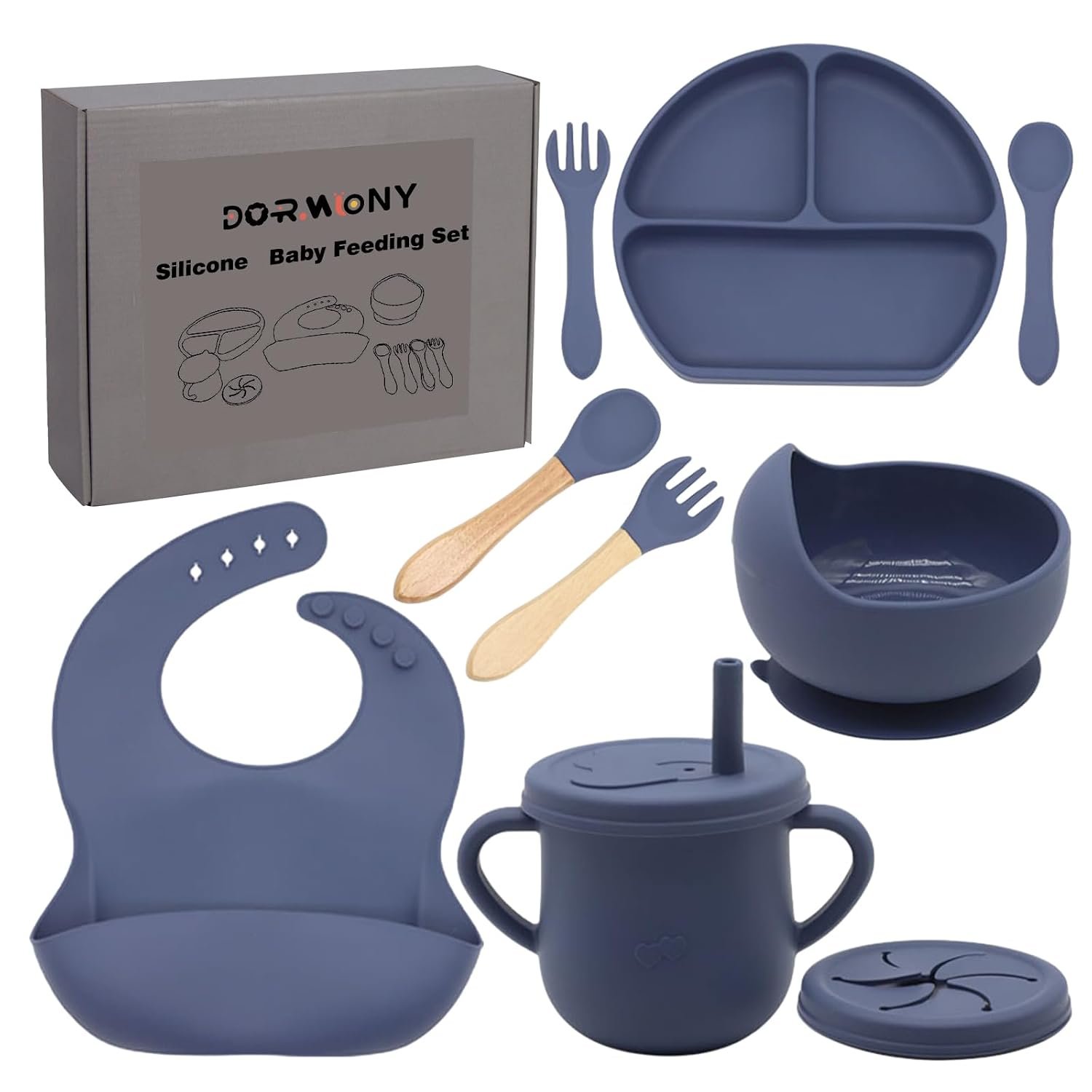
The 100% Silicone Baby Feeding Set from Dormlony is designed as an all-in-one mealtime collection for babies and toddlers. The set is described as including a suction bowl, divided plate, spoons, forks, a sippy cup, and a bib, with the components made from food-contact silicone according to the product listing. The color featured in the product title is Navy Blue.
An integrated feeding set can be useful because it brings several everyday items together rather than requiring parents to purchase each component separately. At the same time, each item serves a different purpose. A suction bowl is designed around stability, a divided plate provides separate sections for different foods, utensils support self-feeding practice, a cup introduces another drinking format, and a bib helps contain some of the mess that naturally accompanies early eating.
Silicone is commonly used in baby feeding products because it is flexible, relatively durable, and can tolerate a range of everyday temperatures. However, material alone does not determine whether a feeding product is appropriate for a particular child. Parents should consider age guidance, supervision, cleaning requirements, food temperature, utensil size, and the child’s individual developmental stage.
This guide explores the main characteristics of this type of silicone baby feeding set, practical ways it can be incorporated into mealtimes, what parents should consider before using it, and how silicone feeding sets compare with other common baby dish materials.
Key Features
Silicone Construction
The product is presented as a 100% silicone baby feeding set. Silicone is a flexible material that is widely used in food-contact products, including baby plates, bowls, utensils, cups, and storage containers.
Its flexibility can be useful during early feeding because silicone dishes are generally less rigid than ceramic or glass alternatives. A silicone plate or bowl can also be more forgiving when a young child drops or pushes it around the table.
The product listing describes the set as BPA-free as well.
Parents should still follow the manufacturer’s instructions regarding cleaning, temperature limits, and intended use. “Silicone” is a material description rather than a guarantee that every component is appropriate for every heating or cooking method.
Suction Bowl
The feeding set includes a suction bowl.
A suction base is designed to help keep the bowl in place on a compatible smooth surface. This feature can be particularly relevant during the transition from parent-assisted feeding to self-feeding, when a child may naturally push, pull, or move dishes while exploring food.
A suction feature does not mean the bowl can never be moved. Its effectiveness depends on the surface, cleanliness, moisture, the strength of the seal, and the child’s actions.
For that reason, parents should still supervise mealtimes rather than relying on the suction base as a restraint.
Divided Plate
The set also includes a divided plate.
Divided plates separate foods into different sections, which can be useful when a child is being introduced to several foods during one meal.
For example, a parent might place a carbohydrate-based food in one section, vegetables in another, and fruit or another suitable food in a third.
The practical advantage is organization. Different foods can remain visually separate instead of becoming mixed together immediately.
This can also make portioning and meal presentation easier for caregivers.
Baby Spoons
Spoons are included for feeding and self-feeding.
A baby spoon typically has a smaller head and handle than standard adult cutlery. This format can make it easier for a young child to practice bringing food toward the mouth.
Self-feeding is a skill that develops gradually. At first, a child may grip the spoon with an entire hand rather than using a mature utensil grip. Spilling is normal during this stage.
The purpose of an appropriately sized spoon is therefore not simply to deliver food efficiently but also to give a child an opportunity to practice coordination.
Forks
The inclusion of forks adds another utensil for developing feeding skills.
A toddler learning to use a fork has to coordinate several actions: holding the utensil, positioning the tines, picking up food, and bringing it toward the mouth.
Parents should choose foods that are appropriate for the child’s developmental stage and prepare them into safe sizes and textures.
The presence of a small fork in a feeding set does not eliminate the need for adult supervision.
Sippy Cup
The set includes a sippy cup, providing a dedicated drinking component.
Transitioning from bottle or breastfeeding to cups can happen gradually and differently for every child. A sippy cup can be one option among several types of training cups.
The cup should be introduced according to the child’s developmental readiness and used according to the manufacturer’s instructions.
It is also important to clean and dry the cup thoroughly, particularly around any lid, valve, or drinking opening where liquid residue can remain.
Bib
The set includes a bib intended to help protect clothing during meals.
Early self-feeding can be messy. Food can fall from utensils, spill from cups, or simply end up on a child’s hands and face while they explore textures.
A bib can reduce the amount of food that reaches clothing, although it cannot eliminate mealtime mess entirely.
The bib should be used comfortably and should not interfere with a child’s movement, breathing, or normal activity.
How It Can Be Used
Introducing Self-Feeding
One of the main purposes of a toddler feeding set is supporting the transition toward more independent eating.
At the beginning, parents may still provide most of the food directly. Over time, the child can be given opportunities to hold a spoon or fork and attempt to feed themselves.
A silicone feeding set can provide the necessary basic equipment in one place.
The process does not need to be rushed. Children develop feeding skills at different rates, and early attempts can be messy.
Serving Mixed Meals
The divided plate can be useful for meals that contain several components.
Instead of placing everything in a single bowl, caregivers can separate foods into sections.
This can make the meal easier to organize and may help children visually identify different foods.
For example, a meal could include soft cooked vegetables, appropriately prepared grains or pasta, and pieces of another suitable food.
The exact foods and preparation methods should always reflect the child’s age and developmental stage.
Bowl-Based Foods
The suction bowl can be useful for foods that are easier to serve from a bowl.
Depending on the child’s stage of feeding, this could include appropriately prepared oatmeal, yogurt, mashed foods, soft grains, or other suitable textures.
The suction base can help reduce accidental movement of the bowl on a compatible surface.
Practicing With Utensils
A child does not need to master spoon and fork use immediately.
Parents can introduce one utensil at a time and allow the child to explore how it works.
A spoon may be easier for some foods, while a fork may work better for soft pieces that can be pierced safely.
The goal is gradual practice rather than perfect table manners.
Learning to Drink From a Cup
The included sippy cup provides another opportunity to practice drinking independently.
Some children transition between cup types quickly, while others take longer.
Parents can introduce the cup during meals and monitor how the child handles it.
The cup should be cleaned promptly after use, particularly when it contains milk or other perishable liquids.
Who May Find This Type of Feeding Set Useful?
Parents Introducing Solid Foods
Parents moving into the complementary-feeding stage may appreciate having several basic feeding items together.
A bowl, plate, utensils, cup, and bib cover several common aspects of mealtime.
Toddlers Practicing Independent Eating
The set’s combination of utensils and dishes can be useful for children who are beginning to take a more active role in feeding themselves.
The child can gradually move from parent-assisted feeding toward holding utensils and managing food independently.
Families Looking for Coordinated Feeding Items
A coordinated set can simplify organization.
Instead of keeping unrelated plates, bowls, spoons, and cups in different locations, caregivers can keep the feeding components together.
Grandparents and Other Caregivers
Multiple caregivers can benefit from having a dedicated set of feeding equipment.
A clearly defined set can help maintain consistency when different adults are responsible for mealtimes.
Families Building a Toddler Mealtime Routine
A predictable feeding setup can become part of a daily routine.
For example, the same bowl and cup can be used during breakfast, while the divided plate can be used for lunch or dinner.
The equipment itself does not establish a routine, but having consistent items can make the routine easier to organize.
Important Things to Consider
Check the Recommended Age
Parents should always check the manufacturer’s recommended age range before using a baby feeding product.
Children develop at different rates, and a product that is appropriate for one toddler may not be appropriate for a younger child.
The size and shape of utensils, drinking components, and dish edges should all be considered alongside the child’s developmental abilities.
Supervision Is Important
Feeding equipment does not replace supervision.
Young children can choke on food, misuse utensils, spill liquids, or place objects in their mouths in unexpected ways.
Parents and caregivers should remain attentive during meals and prepare foods according to recognized age-appropriate feeding and choking-prevention guidance.
Suction Does Not Mean Permanently Fixed
A suction bowl or plate can move if the seal is broken.
The surface underneath should be clean and compatible with the suction base.
Parents should also understand that children may eventually discover how to lift the dish.
The feature should therefore be treated as a convenience rather than a guarantee against spills.
Consider Food Temperature
Silicone can tolerate a range of temperatures, but individual products have specific temperature limits.
Parents should consult the manufacturer’s instructions before putting the dishes into an oven, microwave, dishwasher, freezer, or other appliance.
Even if the material itself can tolerate heat, the complete product may contain components with different requirements.
Food should also be checked for safe temperature before being given to a child.
Cleaning Matters
Baby feeding products require thorough cleaning.
Food residue can remain around plate sections, bowl edges, utensil joints, cup openings, or other areas.
The manufacturer’s cleaning instructions should be followed.
After washing, components should be allowed to dry thoroughly before being stored.
Avoid Assuming “BPA-Free” Means Completely Risk-Free
The product is marketed as BPA-free, which addresses a specific chemical associated with certain plastics.
However, BPA-free is not a general guarantee of safety for every possible use.
Parents should follow the manufacturer’s instructions and use food-contact products as intended.
Check for Damage
Silicone is flexible, but it is not indestructible.
Inspect dishes, utensils, cups, and other components periodically for cuts, tears, cracks, unusual changes, or other damage.
Damaged feeding equipment should be replaced rather than continuing to use it.
Silicone vs. Other Baby Dish Materials
Parents have several material choices when selecting baby feeding equipment.
Silicone
Silicone feeding products are flexible, relatively lightweight, and commonly designed for repeated household use.
They are available in bowls, plates, bibs, utensils, cups, and other feeding accessories.
The flexibility can make silicone dishes easier to handle and less prone to shattering than glass.
Plastic
Plastic baby dishes are also widely available.
They can be lightweight and inexpensive, but the characteristics vary considerably depending on the plastic type and product construction.
Parents should look for clear material information and follow the manufacturer’s instructions for heating and cleaning.
Stainless Steel
Stainless steel dishes are durable and can be resistant to staining and odors.
They are generally more rigid than silicone and can produce more noise when dropped or moved.
Glass
Glass offers a rigid food-contact surface and is easy to inspect visually.
Its primary practical drawback for toddler use is that it can break if dropped.
Bamboo and Composite Materials
Some feeding products use bamboo, wood, or composite materials.
These can have different care requirements, particularly regarding prolonged soaking, dishwasher use, and drying.
The appropriate material depends on the family’s preferences, the child’s age, and how the dishes will be used.
Comparison of General Baby Feeding Set Categories
| Feeding Set Category | Typical Characteristics | Potential Advantages | Main Considerations |
|---|---|---|---|
| Silicone set | Flexible, lightweight, soft-touch feel | Versatile and easy to handle | Follow temperature and cleaning instructions |
| Plastic set | Lightweight and widely available | Often simple to store | Material and heat limitations vary |
| Stainless-steel set | Rigid and durable | Resistant to staining and odors | Less flexible and can be noisy |
| Glass set | Rigid, smooth surface | Easy to inspect and clean | Breakage risk |
| Mixed-material set | Combines several materials | Can provide specialized components | Different components may have different care requirements |
No material is automatically appropriate for every family. The best choice depends on the child’s stage, the caregiver’s preferences, cleaning routine, and intended use.
Organizing the Feeding Set at Home
Keeping feeding equipment organized can make mealtimes easier.
One approach is to store the complete set together in a dedicated drawer or cabinet.
For example, the divided plate and bowl can be stacked, utensils can be placed in a small container, and the cup can be stored separately so it can dry completely.
The bib should also be stored clean and dry.
Keeping everything together can be particularly useful for busy families because the necessary items can be collected quickly before a meal.
Introducing Different Utensils Gradually
Children may not immediately understand the purpose of every utensil.
A simple progression can involve introducing one utensil at a time.
A spoon can be offered with foods that naturally adhere to it. Once the child becomes more comfortable holding a spoon, a fork can be introduced with suitable soft foods.
There is no requirement for every meal to involve both utensils.
The purpose is to give the child repeated opportunities to practice.
Parents can also use their own utensils during meals as a model. Children often learn by observing how adults handle eating equipment.
Using Divided Plates for Meal Variety
A divided plate can make it easier to serve several foods at once.
For example, a caregiver could place:
- A suitable grain or starch in one section
- Soft vegetables in another
- Fruit or another appropriate food in the third
The sections can also help prevent foods with different textures from becoming mixed together.
Some children prefer foods to remain separate, while others do not mind mixed foods.
The divided design simply provides an organizational option.
Cleaning a Silicone Feeding Set
Silicone is generally straightforward to clean, but good hygiene still requires attention.
After each meal, remove leftover food rather than allowing it to remain on the surface for extended periods.
Wash the components using the method recommended by the manufacturer.
Pay particular attention to:
- Bowl edges
- Plate dividers
- Spoon surfaces
- Fork tines
- Cup openings
- Any cup components or seals
- Areas around the suction base
- Bib surfaces and fastening areas
After cleaning, allow the pieces to dry completely.
If a component develops an unusual odor that does not disappear with normal cleaning, inspect it and consult the manufacturer’s care instructions.
Sippy Cup Considerations
The included cup deserves particular attention because cups can have more components than a simple plate or bowl.
Liquid can remain around lids, openings, valves, or seals.
If the design includes removable components, they should be disassembled and cleaned according to the manufacturer’s instructions.
Milk and other liquids can spoil when left at room temperature for extended periods.
The cup should therefore be emptied and cleaned promptly after use.
As a child develops, caregivers can also discuss with a pediatric professional when and how to transition from a sippy cup to an open cup or another age-appropriate drinking method.
Bib Use During Self-Feeding
A bib can be especially useful during the early self-feeding stage.
Children often touch food before eating it, drop pieces, wipe their hands, and experiment with different textures.
The bib helps keep some of this food away from clothing.
It is still important to check the fit. The bib should not be overly tight or interfere with the child’s natural movement.
After meals, the bib should be cleaned according to its material and care instructions.
Frequently Asked Questions
What is included in this baby feeding set?
The product listing describes a set that includes a suction bowl, divided plate, spoons, forks, a sippy cup, and a bib. The product is presented in a Navy Blue color.
Is the feeding set made from silicone?
The product is marketed as a 100% silicone baby feeding set. The listing also describes it as BPA-free.
Does the set include a suction bowl?
Yes. A suction bowl is one of the components described in the product listing.
What is the purpose of the suction base?
The suction base is designed to help keep the bowl in place on a compatible smooth surface.
It can reduce unwanted movement, but it should not be considered impossible for a determined toddler to lift or move.
Does the set include a divided plate?
Yes. The feeding set includes a divided plate designed to separate different foods into sections.
Does it include baby utensils?
Yes. The set includes spoons and forks intended for baby or toddler mealtime use.
Is a cup included?
Yes. The product listing identifies a sippy cup as part of the set.
Does the set include a bib?
Yes. A bib is included as part of the feeding set.
Is the feeding set dishwasher safe?
The appropriate cleaning method should be confirmed using the manufacturer’s current care instructions for the specific product.
Even when silicone components are dishwasher compatible, cup parts or other accessories may have separate cleaning requirements.
Can silicone baby dishes be used in the microwave?
Parents should not assume that every silicone feeding product is microwave-safe simply because it is made from silicone.
Check the manufacturer’s instructions for the specific product and component before microwave use.
Can the suction bowl prevent spills completely?
No. Suction can help reduce movement on compatible surfaces, but it does not guarantee that a toddler cannot move, lift, or tip the bowl.
Adult supervision remains important.
Can the feeding set be used for hot food?
Silicone products can tolerate heat within specified limits, but the manufacturer’s temperature instructions should be followed.
Food should also be cooled to a safe temperature before being offered to a baby or toddler.
Is the set suitable for babies and toddlers?
The product is marketed as a baby and toddler feeding set.
Parents should still check the manufacturer’s recommended age and consider the individual child’s developmental readiness before using each component.
Is silicone safer than plastic?
The answer depends on the specific material, manufacturing standards, and intended use.
Silicone and plastic are broad material categories. A feeding product should be evaluated based on its stated composition, intended use, care instructions, and applicable safety information rather than material name alone.
How should the utensils be introduced?
Utensils can be introduced gradually during supervised meals.
A child can begin by holding a spoon and experimenting with bringing it toward the mouth. Forks can be introduced with suitable foods as coordination develops.
Why use a divided plate?
A divided plate separates different foods into sections.
This can make meals easier to organize and can be useful for children who prefer foods to remain separate.
How should the sippy cup be cleaned?
Follow the manufacturer’s cleaning instructions and pay particular attention to any lid, drinking opening, valve, or seal where liquid can remain.
Thorough drying is also important.
What should parents do if a silicone component becomes damaged?
If a feeding component develops a tear, crack, cut, significant deformation, or another defect that could affect safe use, it should generally be replaced.
Conclusion
The 100% Silicone Baby Feeding Set from Dormlony brings several everyday feeding accessories together in one coordinated collection. The product listing describes a suction bowl, divided plate, spoons, forks, sippy cup, and bib, with the set marketed as BPA-free and made from silicone.
Each component serves a different role during the transition toward more independent eating. The suction bowl is intended to reduce unwanted movement on a compatible surface, the divided plate separates foods, utensils provide opportunities to practice self-feeding, the cup supports drinking practice, and the bib helps manage some of the mess associated with early meals.
Silicone is a practical material for many baby feeding applications because of its flexibility and everyday durability, but the material itself does not eliminate the need for proper care. Parents should follow the manufacturer’s instructions regarding temperature, cleaning, dishwasher or microwave use, and storage.
The most important consideration is the child’s developmental stage. A feeding set can provide useful equipment, but children still need appropriate food preparation, close supervision, and gradual opportunities to develop their feeding skills. Features such as suction bases and small utensils are helpful tools rather than replacements for attentive caregiving.
Compared with plastic, stainless steel, glass, and mixed-material feeding sets, silicone provides a different combination of flexibility, handling characteristics, and maintenance requirements. The right choice depends on how the family plans to use the dishes, how frequently they will be cleaned, and which features are most useful for the child’s current stage.
For families looking for a coordinated collection of baby feeding dishes and accessories, the set provides several commonly used mealtime items in one package.
You can check more details on Amazon here.
As an Amazon Associate, we earn from qualifying purchases.
Leave a Reply