Introduction
A practical tool storage system does more than provide a place to put tools. For people who work with hand tools regularly, the way equipment is organized can influence how quickly individual tools can be found, transported, and returned to storage. This is especially true for electricians, maintenance workers, technicians, contractors, installers, and DIY users who may move between a workshop, vehicle, job site, and home.
A soft-sided toolbox offers a different approach from a traditional metal or molded plastic tool case. Instead of creating a rigid enclosed compartment, it combines a central storage area with exterior pockets that can keep commonly used tools visible and accessible.
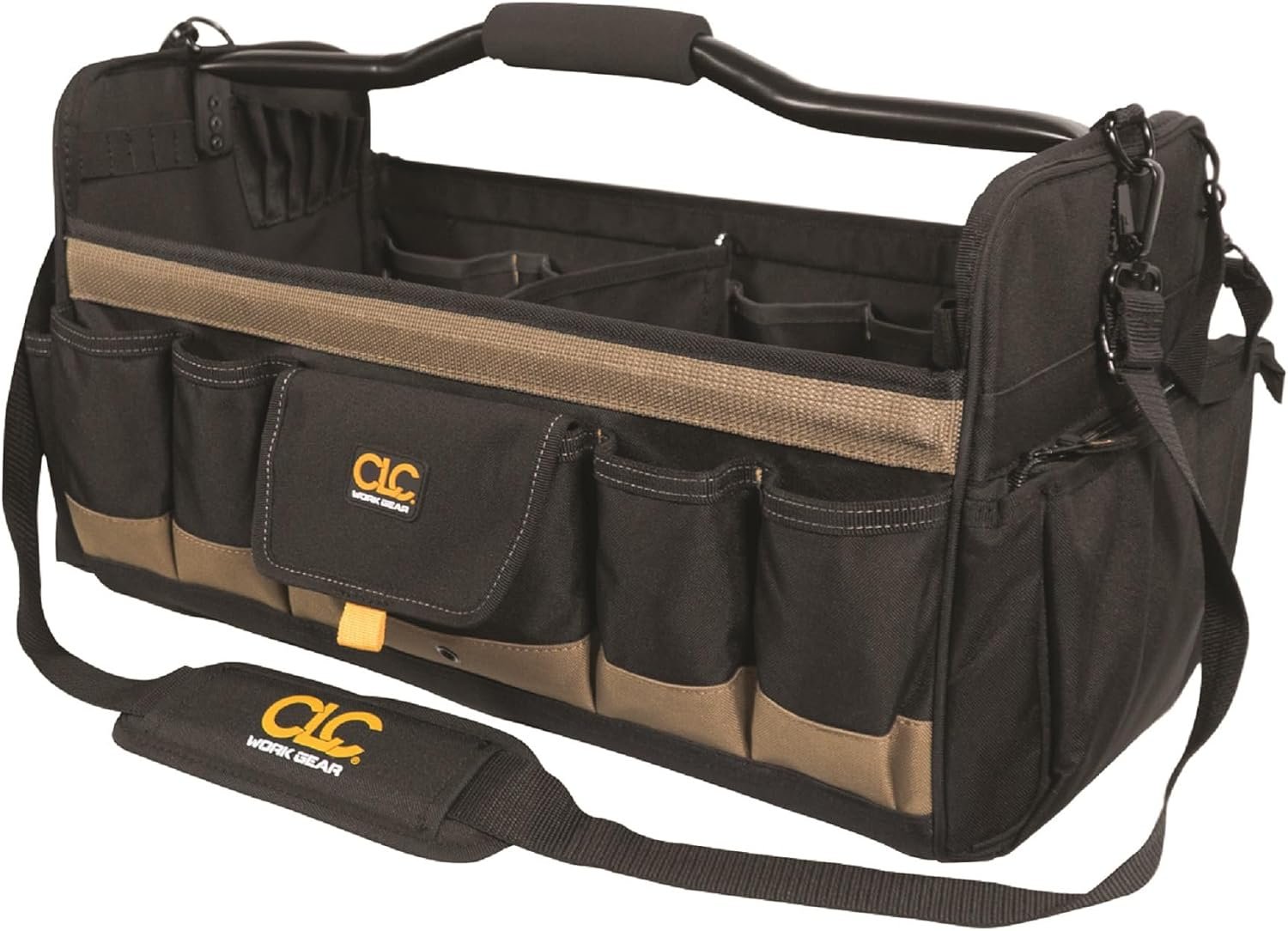
The Custom Leathercraft WORK GEAR 1579 20-Inch Open Top Soft-Sided Tool Box is designed around this type of organization. The product is a 20-inch open-top tool bag with 27 pockets, providing a combination of central storage and external compartments for tools and accessories. It is part of the WORK GEAR range from Custom Leathercraft, a brand known for tool-storage products aimed at tradespeople and general users.
The open-top format is particularly relevant for people who frequently access their tools throughout the day. Rather than opening and closing a hinged lid each time a tool is needed, the user can reach directly into the main compartment or select a tool from one of the outside pockets.
At the same time, an open-top bag has limitations. It does not provide the same level of protection against dust, rain, or impact as a fully enclosed hard case. Its capacity also depends on how the user organizes the tools, and a heavily loaded bag can become difficult to carry.
This guide explains the design and practical characteristics of the Custom Leathercraft 1579, how its pocket layout can be used, what types of users may find this format useful, and what to consider when comparing it with other toolbox categories.
What Is the Custom Leathercraft WORK GEAR 1579?
The WORK GEAR 1579 is a 20-inch soft-sided, open-top tool bag designed for transporting and organizing hand tools.
Its defining characteristic is its combination of a large central compartment and numerous external pockets. The manufacturer describes the bag as having 27 pockets, giving users multiple locations for organizing different categories of equipment.
Rather than requiring every tool to be placed into one large compartment, the pocket layout allows commonly used items to remain separated.
For example, screwdrivers can be placed in dedicated vertical pockets, pliers can be kept in another section, and measuring equipment can be stored where it is easy to reach.
This type of organization is different from a traditional toolbox with one large cavity and a removable tray.
The 1579 is intended more as a portable work bag that keeps tools readily accessible throughout the workday.
Key Features
20-Inch Tool Bag Format
The 1579 is built around a 20-inch size, making it larger than compact personal tool bags while remaining within the general category of portable hand-tool storage.
A 20-inch bag can accommodate a substantial selection of hand tools, but the actual capacity depends heavily on the size and shape of the equipment being carried.
A bag filled with lightweight screwdrivers and pliers will behave differently from one loaded with heavy wrenches, power tools, or large accessories.
The size should therefore be viewed as an indication of the bag’s overall format rather than a guarantee of a specific number of tools it can carry.
Open-Top Design
The open-top design is one of the most practical features of the 1579.
There is no conventional lid covering the main compartment. Instead, the user has direct access to the tools inside.
This can be useful when a technician repeatedly switches between different tools.
For example, during an installation job, the worker may need a screwdriver, pliers, measuring tape, fasteners, and a utility knife several times during the same task.
An open bag eliminates the repeated step of opening and closing a rigid toolbox.
The tradeoff is that the tools are more exposed to the surrounding environment and may be less protected during transportation.
27 Pockets
The toolbox provides 27 pockets for organizing tools and accessories.
Multiple pockets can be useful because hand tools come in many shapes and sizes.
Long narrow tools can be separated from smaller accessories, while frequently used items can be placed in the most accessible locations.
This arrangement also provides visual organization. Instead of searching through a deep pile of tools, the user can often identify a tool by looking at its pocket.
The pocket count is a structural feature rather than a recommendation that every pocket should be filled. Overloading all available pockets can make the bag heavier and may reduce the convenience of carrying it.
Soft-Sided Construction
Unlike a steel toolbox or molded plastic case, the WORK GEAR 1579 uses a flexible soft-sided construction.
Soft-sided bags have several practical characteristics.
They can conform slightly around tools and accessories, can be easier to store in vehicle compartments, and generally do not have the same rigid shape as a traditional toolbox.
The flexibility can also make it easier to place the bag in a crowded work vehicle.
However, soft-sided construction provides less structural protection than a hard case. Sharp tools should therefore be positioned carefully to avoid damaging the bag or surrounding equipment.
Central Main Compartment
The pockets provide organization around the outside, while the main compartment can accommodate larger tools or groups of equipment.
This is useful for tools that do not fit neatly into narrow pockets.
For example, a worker may keep a small level, electrical tester, gloves, fastener containers, or other larger accessories in the main section.
The open compartment also allows the user to see the contents without opening a lid.
Portable Tool Storage
The basic purpose of the 1579 is mobility.
A portable tool bag can move between a truck, workshop, construction site, maintenance area, and building interior.
This makes it different from large rolling tool cabinets or stationary workshop storage.
A worker can create a job-specific tool selection and carry it directly to the work area.
How It Can Be Used
Electrical Work
Electricians frequently carry many relatively small hand tools.
A soft-sided organizer can provide separate locations for screwdrivers, pliers, cutters, testers, measuring tools, and other equipment.
The pockets can keep tools upright and visible.
Electrical components should still be handled according to appropriate safety procedures, and the bag itself should not be treated as protection against electrical hazards.
Plumbing and Maintenance
Plumbers and maintenance technicians may need a mixture of hand tools, fittings, measuring equipment, and small accessories.
A 20-inch open-top bag can provide a central location for the equipment needed for a particular service call.
The exterior pockets can be assigned to frequently used tools, while the main compartment can hold larger equipment.
Carpentry
Carpenters often work with measuring and layout tools alongside hand tools.
A tool bag can accommodate items such as tape measures, squares, screwdrivers, pliers, utility knives, and other accessories.
The open design can make repeated access easier while working on a project.
General Construction
Construction workers may need to carry a changing selection of tools depending on the task.
The 27-pocket configuration allows a user to create a personalized organization system.
A worker can keep frequently used tools in exterior pockets and reserve the central compartment for larger items.
Home Maintenance
The bag can also be useful for homeowners who prefer to keep common household tools together.
Rather than storing individual tools in different drawers, a dedicated tool bag can serve as a portable maintenance kit.
This can be especially useful for users who work on multiple areas of a house and do not want to repeatedly return to a workshop.
Automotive Maintenance
A soft-sided tool bag can be useful for transporting hand tools around a garage or workshop.
The pockets can hold frequently used tools while larger items remain in the main compartment.
For automotive work, however, very heavy tools and metal components should be distributed carefully to avoid making the bag unnecessarily difficult to carry.
Who May Find This Tool Bag Useful?
Professional Tradespeople
Electricians, plumbers, carpenters, installers, HVAC technicians, and maintenance workers often need portable tool storage.
A bag with multiple pockets can provide a practical way to keep frequently used tools organized.
Service Technicians
Technicians moving between customer locations may prefer a portable bag over a large toolbox.
The open-top design can also make it easier to access tools during service calls.
Contractors
Contractors can configure the bag around the specific requirements of a project.
A worker handling one type of task can select the relevant tools and leave unrelated equipment in the workshop or vehicle.
DIY Users
Homeowners can use a tool bag to maintain a core set of household tools.
A portable design makes it possible to carry the tools to different rooms or outdoor work areas.
Workshop Users
Even when most tools are stored in a larger cabinet, a portable tool bag can function as a secondary “job kit.”
The user can select the tools needed for a specific task and carry them away from the main workstation.
Organizing the 27 Pockets
Having many pockets is useful only if they are organized deliberately.
A simple system is to assign different tool categories to different areas.
For example:
- Screwdrivers in narrow vertical pockets
- Pliers and cutters in adjacent pockets
- Measuring tools in accessible outer pockets
- Utility knives in secure locations
- Gloves and protective equipment in the main compartment
- Fastener containers in the central storage area
- Frequently used tools closest to the carrying position
The exact arrangement should reflect the user’s work.
There is no universal pocket layout because electricians, carpenters, mechanics, and DIY users carry different tools.
The most important goal is consistency.
If every tool has a designated place, missing equipment becomes easier to notice.
Open-Top vs. Closed Toolboxes
One of the most significant decisions when choosing portable tool storage is whether to use an open or enclosed design.
Open-Top Tool Bags
An open-top bag provides direct access.
The user can see the tools immediately and remove them without opening a lid.
This can save small amounts of time throughout the day, particularly for jobs requiring frequent tool changes.
The downside is exposure. Dust, moisture, debris, and other environmental factors can reach the tools more easily.
Hard Tool Cases
A hard case typically provides more protection from impact and environmental exposure.
The contents are enclosed and may be easier to secure during transportation.
However, accessing a tool requires opening the case, and the interior can become disorganized if there are few dedicated compartments.
Traditional Metal Toolboxes
Metal toolboxes provide rigid construction and are often used for general workshop storage.
They can be durable, but they may also be heavier and less flexible than soft-sided bags.
The choice depends on the work environment and the type of tools being transported.
Comparison of General Tool Storage Categories
| Storage Type | Accessibility | Protection | Portability | Organization |
|---|---|---|---|---|
| Open-top soft tool bag | Very direct | Moderate | High | Multiple pockets |
| Hard tool case | Requires opening | Higher | Moderate | Depends on interior design |
| Metal toolbox | Requires opening | High | Moderate to low depending on size | Trays and compartments vary |
| Rolling toolbox | Accessible but larger | High | Easy on suitable surfaces | Often extensive |
| Tool backpack | Direct through compartments | Moderate | High | Multiple internal sections |
This comparison is intended to show the general differences between storage formats rather than identify one category as universally preferable.
Important Things to Consider
Weight
The empty bag may be easy to carry, but the weight of the tools can add up quickly.
Twenty or more pockets can encourage users to carry more equipment than they actually need.
A practical approach is to select tools based on the specific job rather than filling every available compartment.
Tool Size
Not every tool will fit conveniently into a pocket.
Large adjustable wrenches, long levels, bulky pliers, and other oversized equipment may be better placed in the main compartment or carried separately.
Before organizing the bag, it is useful to identify the tools that need dedicated pocket space.
Soft-Sided Protection
Soft-sided construction provides flexibility, but it does not provide the same impact protection as a rigid case.
If the bag is placed in a truck bed or exposed to heavy equipment, the tools and bag should be secured appropriately.
Sharp tools should also be positioned so they do not cut or puncture the material.
Weather Exposure
An open-top tool bag should not be assumed to be waterproof.
If the bag is used outdoors, it should be protected from rain and excessive moisture whenever possible.
Moisture can cause corrosion on metal tools and can affect other equipment stored inside.
Security
Because the bag is open at the top, it does not provide the same level of theft resistance as a locked toolbox.
When working in public areas or leaving a vehicle unattended, valuable tools should be secured appropriately.
Carrying Distance
A heavily loaded 20-inch tool bag can become tiring to carry over long distances.
If a job requires moving tools across a large site, a rolling tool case, backpack, cart, or other transport solution may be more appropriate.
Maintaining a Soft-Sided Tool Bag
Tool bags generally require less mechanical maintenance than powered equipment, but regular care can still extend their useful life.
Clean the Interior
Dust, metal filings, sawdust, and other debris can accumulate inside the bag.
Emptying and cleaning the interior periodically can prevent debris from damaging the material or tools.
Inspect the Pockets
Pockets experience repeated stress when tools are inserted and removed.
Check seams, edges, and pocket bottoms for signs of wear.
Inspect the Handles
The carrying handle supports the entire loaded weight of the bag.
Inspect it periodically for fraying, loose stitching, or other damage.
Avoid Excessive Loading
Even if the bag physically accepts more tools, overloading can place unnecessary stress on the seams and handles.
A lighter, job-specific load is often easier to carry and organize.
Keep Tools Clean
A toolbox can become dirty when tools are returned immediately after use.
Cleaning tools before storing them helps keep the bag cleaner and reduces the transfer of grease, dirt, and metal debris to other equipment.
Creating a Job-Specific Tool Kit
One useful way to use a multi-pocket tool bag is to create dedicated tool configurations.
For example, a homeowner could create a basic household-maintenance kit.
An electrician could organize a bag around electrical installation tasks.
A carpenter could dedicate one to layout and finishing work.
A service technician might create a bag specifically for routine diagnostic visits.
This approach avoids carrying every tool available.
It also makes it easier to identify missing tools before leaving the workshop.
Tool Visibility and Workflow
One advantage of multiple external pockets is visibility.
A worker can often identify whether a screwdriver or pair of pliers is present without searching through a closed compartment.
This can be useful during tasks where tools are frequently exchanged.
The organizational system works best when the same tools are returned to the same locations.
If a screwdriver normally belongs in one pocket but is repeatedly placed in the main compartment, the advantage of the pocket system is reduced.
A consistent workflow therefore matters as much as the physical design of the bag.
Using the Main Compartment Effectively
The central compartment should generally be reserved for items that are too large for the pockets or that do not need to be accessed as frequently.
For example, it might hold:
- Gloves
- Small tool cases
- Electrical accessories
- Fastener containers
- Larger hand tools
- Measuring equipment
- Protective equipment
Avoid filling the central compartment with loose small items when a separate container can keep them organized.
A small collection of loose fasteners can quickly make a tool bag difficult to search.
Frequently Asked Questions
What size is the Custom Leathercraft WORK GEAR 1579?
The model is identified as a 20-inch tool bag. The 20-inch designation refers to the bag’s overall size category rather than the capacity of any individual pocket.
How many pockets does the 1579 have?
The product is designed with 27 pockets, providing multiple locations for organizing hand tools and accessories.
Is the 1579 an open-top tool bag?
Yes. It uses an open-top design that provides direct access to the main compartment.
What types of tools can be stored in it?
The bag can be used for many common hand tools, including screwdrivers, pliers, cutters, measuring tools, utility knives, and other equipment that fits within the available pockets or main compartment.
Is the bag suitable for electricians?
A multi-pocket open-top design can be useful for electricians who carry numerous small hand tools.
The exact tool selection depends on the work being performed.
Can plumbers use this tool bag?
Yes, a tool bag of this type can be used to organize many plumbing hand tools and accessories.
Larger or particularly heavy equipment may be better transported separately.
Is it suitable for automotive tools?
It can be used for transporting automotive hand tools, particularly for mobile maintenance tasks.
Users should consider the weight of automotive tools because a fully loaded bag can become difficult to carry.
Is the tool bag waterproof?
An open-top soft-sided tool bag should not be assumed to be waterproof.
It is better suited to environments where the contents can be protected from significant rain and moisture.
Can the bag be used outdoors?
Yes, it can be carried to outdoor job sites, but exposure to rain, mud, dust, and other environmental conditions should be considered.
The tools themselves should also be protected against corrosion and moisture.
Does an open-top design provide better access?
It can provide direct access because the user does not have to open a lid before reaching the tools.
This can be useful when a worker repeatedly changes tools during a task.
Is the bag suitable for heavy tools?
The bag can carry tools, but the total load should be kept practical for the carrying system and the user’s ability to transport it safely.
Heavy tools can make a soft-sided bag cumbersome.
Does having 27 pockets mean every tool needs its own pocket?
No. The pockets are organizational options.
The main compartment can be used for larger items, while the exterior pockets can be assigned to frequently used tools.
Can it replace a workshop toolbox?
It can serve as portable storage, but it does not necessarily replace a larger workshop toolbox.
A stationary toolbox typically provides more overall capacity and greater protection.
How should tools be organized?
A useful approach is to place frequently used tools in the most accessible pockets and reserve the main compartment for larger items.
The exact layout should reflect the user’s work.
How can the bag be kept in good condition?
Keep the bag reasonably clean, inspect handles and seams, avoid excessive loading, and protect it from unnecessary moisture and harsh environmental exposure.
What should be done if a pocket becomes damaged?
A damaged pocket should be assessed before continuing to store tools in it.
If a tool could fall through or the damage could spread, repair or replacement may be appropriate.
Conclusion
The Custom Leathercraft WORK GEAR 1579 20-Inch Open-Top Soft-Sided Tool Box is designed around a straightforward idea: provide portable tool storage that keeps frequently used equipment organized and accessible.
Its 20-inch format, open-top main compartment, and 27-pocket configuration give users multiple ways to arrange hand tools and accessories. Instead of placing everything into one deep compartment, a worker can assign individual pockets to commonly used tools while using the central section for larger equipment.
This design can be useful across many environments, including electrical work, plumbing, carpentry, general construction, maintenance, automotive work, and household projects. Professional tradespeople can configure it as a job-specific kit, while homeowners can use it as a portable household maintenance bag.
The open-top construction is one of its defining characteristics. It provides quick access and excellent visibility, but it also means the tools are more exposed than they would be inside a closed hard case. Users working outdoors should take appropriate precautions against rain and moisture, while anyone transporting valuable tools should consider the bag’s limited security compared with a locking toolbox.
Weight is another important consideration. Twenty-seven pockets provide plenty of organizational possibilities, but that does not mean every pocket needs to be filled. Carrying only the tools required for a particular task can make the bag easier to transport and reduce unnecessary stress on its handles, seams, and pocket construction.
Compared with hard cases, metal toolboxes, rolling storage systems, and tool backpacks, a soft-sided open-top bag occupies a distinct position. Its main strengths as a category are direct access, portability, and flexible organization. Its limitations include lower environmental protection and less rigid structural protection than enclosed cases.
For anyone considering this type of portable tool storage, the most useful question is not simply how many tools the bag can hold, but how well its organization matches the work being performed. A carefully arranged tool bag can make a mobile job kit easier to transport, easier to inspect, and easier to access throughout the day.
If the 20-inch format and 27-pocket organization match your tool-storage needs,
you can check more details on Amazon here.
As an Amazon Associate, we earn from qualifying purchases.
Leave a Reply