Introduction
An all-terrain vehicle can be useful for much more than transportation. On farms, large properties, hunting land, landscaping jobs, grounds-maintenance operations, and winter service work, an ATV can become a practical mobile platform for distributing materials across areas that would be difficult to cover efficiently by hand.
A broadcast spreader mounted to an ATV takes advantage of that mobility. Instead of carrying a handheld spreader or repeatedly walking back to a supply pile, an operator can transport a larger quantity of free-flowing material and distribute it while traveling across the property.
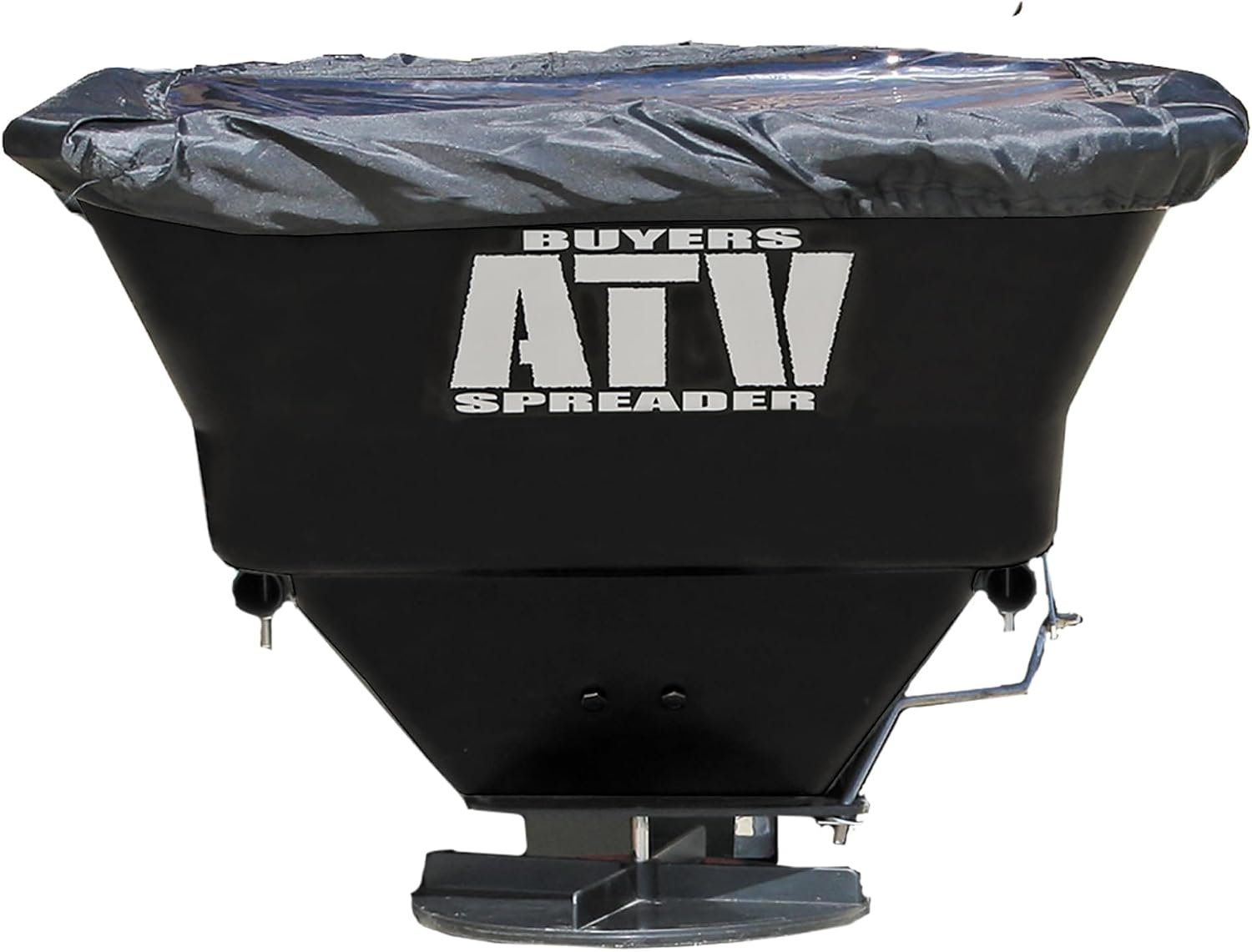
The Buyers Products ATVS100 100 lb ATV Rear Rack Mount Broadcast Spreader is designed around this concept. It uses a polyethylene hopper with a stated 100-pound capacity, a 12-volt motor, a manual feed-gate regulator, and a broadcast distribution system. Buyers Products describes the ATVS100 as an all-purpose ATV spreader intended for applications including landscaping, groundskeeping, farming, and hunting. It can distribute free-flowing materials such as seed, feed, and many fertilizers, while the manufacturer also describes seasonal applications involving salt and ice melt.
Published specifications identify a maximum spread width of up to 30 feet, although actual coverage depends on the material, application settings, travel speed, environmental conditions, and other factors.
The ATVS100 is therefore not simply a fertilizer spreader. Its design is aimed at providing a versatile material-distribution system that can be attached to an ATV’s rear utility rack and used for different types of seasonal work.
This guide explains the product’s main characteristics, how an ATV broadcast spreader works, practical applications, material considerations, installation factors, maintenance, and the differences between several general categories of spreading equipment.
What Is the Buyers Products ATVS100?
The ATVS100 is an ATV-mounted broadcast spreader with a horizontal rack-mount configuration.
Rather than being towed behind the ATV, the spreader is mounted to the vehicle’s rear utility rack. Buyers Products states that the spreader mounts directly to an existing rear utility rack and is intended for ATVs equipped with a suitable rear metal rack.
The hopper holds up to 100 pounds of free-flowing material. A 12-volt motor powers the spreading mechanism, while a manual feed-gate regulator controls the amount of material being released. The controls are designed to be accessible from the ATV seat.
The result is a setup in which one vehicle can transport and distribute material across a property without requiring a separate walk-behind spreader for every task.
Because the ATVS100 is designed for free-flowing material, the characteristics of the material being spread are important. Granules, seeds, feed, fertilizer, salt, and ice-melt products can have significantly different flow characteristics, so the correct setting and operating method can vary.
Key Features
100-Pound Hopper Capacity
The ATVS100 has a stated hopper capacity of 100 pounds.
For an ATV-mounted spreader, this provides a substantial material load while still keeping the equipment within a relatively compact form.
The actual amount an operator should load depends on more than the hopper’s nominal capacity. The ATV itself has a maximum payload, and the weight of the spreader must be considered together with the material and any other equipment or cargo being carried.
A full hopper therefore should not automatically be assumed to be appropriate for every ATV.
Operators should consult the ATV manufacturer’s specifications before loading the spreader.
Polyethylene Hopper
The hopper is made from polyethylene, and Buyers Products describes it as durable and rust-resistant.
Polyethylene is widely used in agricultural, landscaping, and material-handling equipment because it does not rust in the same manner as conventional steel.
For a spreader that may be used with fertilizer, salt, or other potentially corrosive materials, the choice of hopper material can be particularly relevant.
The hopper still requires appropriate cleaning and maintenance. Resistance to rust does not mean that the material is immune to chemical exposure, impact, ultraviolet degradation, or general wear.
12-Volt Electric Motor
The ATVS100 uses a 12-volt motor located inside the hopper. Buyers Products states that positioning the motor inside the hopper helps protect it during operation.
The 12-volt electrical design allows the spreader to use the ATV’s electrical system rather than requiring a separate engine.
A vehicle-powered spreader can simplify operation because the operator can control the equipment from the ATV while moving through the work area.
Electrical connections should nevertheless be installed and maintained carefully, particularly when the ATV is used in wet, muddy, dusty, or corrosive environments.
Manual Feed-Gate Regulation
Material flow is controlled using a manual feed-gate regulator. Buyers Products describes the direct linkage as providing control over the amount of material being released.
This is important because different materials require different application rates.
A seed product, fertilizer, salt, and feed can behave differently inside the hopper. The operator may therefore need to adjust the gate according to the material and desired application.
The setting should be calibrated rather than assumed.
For example, an operator can conduct a small test application over a known distance or area and compare the amount of material used with the desired application rate.
Broadcast Spreading
The ATVS100 is designed as a broadcast spreader rather than a narrow-drop spreader.
Broadcast spreading distributes material outward from the machine, allowing the ATV to cover a broader path as it travels.
Buyers Products lists a spread width of up to 30 feet.
The actual working width can be considerably different depending on the material and conditions.
An advertised maximum width should therefore be treated as a specification rather than a guarantee that every material will consistently reach that distance.
Rain Cover
The spreader includes a rain cover designed to protect material in the hopper from the elements.
This is particularly useful when the material is sensitive to moisture.
Seeds, fertilizer granules, and some salt products can absorb moisture or develop flow problems if they become wet. Keeping the hopper covered when appropriate can help reduce unnecessary exposure.
The cover does not eliminate the need for proper storage or guarantee that material will remain completely dry in all weather conditions.
Rear Rack Mounting
The ATVS100 mounts to an ATV’s rear utility rack. Buyers Products specifically describes the product as a horizontal rack-mount spreader.
This configuration keeps the spreading equipment directly attached to the ATV rather than extending behind it like a tow-behind unit.
That can be useful in tighter working environments where maneuverability matters.
However, mounting equipment on the rear rack changes the ATV’s weight distribution and should always be considered in relation to the vehicle manufacturer’s recommendations.
Controls Accessible From the Seat
The power switch and controls are designed to be accessible while the operator remains seated on the ATV.
This means the operator can control the spreading process without repeatedly stopping to operate a separate handheld mechanism.
The practical advantage is particularly relevant when covering larger properties.
How It Can Be Used
Lawn Fertilization
One of the most common applications for an ATV spreader is distributing granular fertilizer across lawns and larger grassy areas.
The ATV provides mobility while the spreader handles the material distribution.
Application rate is critical. Too little material may fail to provide the intended coverage, while excessive application can damage vegetation and waste product.
Operators should follow the fertilizer manufacturer’s application instructions and calibrate the spreader accordingly.
Grass and Pasture Seeding
The ATVS100 can also be used for distributing suitable free-flowing seed. Buyers Products specifically identifies planting seeds as one of the warm-season applications for the spreader.
Large fields and rough pasture areas can be easier to cover with an ATV than with a handheld broadcast spreader.
Seed size, shape, moisture content, and density can all influence how it moves through the hopper and across the spinner.
A calibration test can help establish the appropriate gate setting and travel speed.
Livestock Feed
Buyers Products identifies feed as another material that can be distributed with the ATVS100.
This can be relevant on farms, ranches, hunting properties, and managed wildlife areas.
Feed should only be used in the spreader when its physical characteristics are appropriate for the equipment.
After switching between materials, the hopper and spreading components should be cleaned appropriately to avoid cross-contamination.
Hunting and Wildlife Management
The manufacturer lists hunting among the product’s intended application categories.
On large properties, an ATV-mounted spreader can help distribute suitable wildlife feed or seed across designated areas.
Local wildlife regulations and land-management requirements should always be followed when distributing feed or attractants.
Winter Salt and Ice Melt
The ATVS100 can also be used seasonally for distributing salt or ice melt. Buyers Products describes this as a winter application for driveways, parking areas, and sidewalks.
This gives the spreader a broader seasonal role than equipment designed solely for lawn fertilizer.
However, not every salt or de-icing material behaves identically. Moisture, particle size, density, and tendency to clump can influence flow through the hopper.
Operators should verify that the specific material is suitable before loading it.
Grounds Maintenance
Large parks, estates, campuses, sports facilities, and commercial properties can require repeated material distribution.
An ATV-mounted spreader can provide a mobile solution where a truck or tractor would be unnecessary or difficult to maneuver.
The relatively compact vehicle combination can be useful for narrow access routes, rough terrain, and landscaped areas.
Who May Find the ATVS100 Useful?
Property Owners With Large Land Areas
Owners of large rural properties may use an ATV for mowing, trail maintenance, fence inspection, and other tasks.
Adding a spreader can extend the vehicle’s usefulness to seed and fertilizer distribution.
Farmers and Ranchers
Farm operations can use ATV-mounted equipment for smaller distribution tasks where bringing out a larger tractor would be inefficient.
The spreader can potentially handle seed, feed, and other appropriate free-flowing materials.
Landscaping Professionals
Landscaping companies working across large lawns, commercial properties, and estates may use an ATV to cover areas where a truck-mounted spreader would not be practical.
Groundskeeping Teams
Golf courses, parks, campuses, and recreational facilities often need equipment capable of moving through landscaped areas.
An ATV spreader can become part of a broader grounds-maintenance fleet.
Hunting Property Managers
For properties where permitted wildlife-management activities involve distributing appropriate feed or seed, the ATV provides mobility while the spreader handles the distribution.
Important Things to Consider
Check ATV Payload Capacity
The 100-pound hopper capacity is not the same thing as the allowable payload of the ATV.
The spreader itself adds weight, and the loaded material adds substantially more.
An operator also has to account for the rider and any other equipment attached to the vehicle.
The ATV manufacturer’s payload and rack-load limits should therefore be checked before operating a loaded spreader.
Consider Rear Rack Capacity
The spreader attaches to the rear utility rack, which means the rack itself becomes part of the load-bearing system.
A rear rack may have a specific maximum load rating.
Even if the spreader can physically be attached, the rack must be capable of handling the combined weight and dynamic forces created while riding over uneven terrain.
Weight Distribution Matters
Adding a large load behind the ATV can change handling characteristics.
A full hopper positioned at the rear can affect balance, traction, braking, and steering behavior.
Operators should become familiar with the manufacturer’s recommendations for carrying rear-mounted loads and should avoid excessive speed or aggressive maneuvering when the spreader is loaded.
Material Must Be Free-Flowing
The ATVS100 is intended for free-flowing materials. Buyers Products specifically mentions seed, feed, and most fertilizers.
Materials that clump, contain excessive moisture, or are otherwise difficult to flow may not distribute consistently.
The hopper should not be overloaded in an attempt to compensate for poor material flow.
Calibrate the Application Rate
The feed-gate setting should not simply be left at the same position for every material.
Fertilizer application rates vary by product. Seed varies by species and planting requirements. Salt and ice melt products can also have different recommended application rates.
Calibration helps reduce waste and improve consistency.
A practical approach is to measure the amount of material discharged over a known distance or time and adjust the gate and travel speed accordingly.
Maximum Spread Width Is Not Universal
The listed maximum spread width is 30 feet.
That does not mean every material will spread evenly over a 30-foot path.
The distribution pattern depends on material characteristics, spinner behavior, vehicle speed, gate setting, wind, terrain, and other conditions.
For precise applications, the operator should verify the actual pattern rather than relying solely on the maximum published number.
Weather Conditions Matter
Wind can affect broadcast distribution.
Light granular material or seed may be carried farther in one direction, creating uneven coverage.
Rain and humidity can also affect material flow.
The included rain cover can protect the hopper while the equipment is not actively distributing material, but it does not remove the effects of weather during operation.
Preparing Material for the Spreader
Material preparation can have a major impact on performance.
Before filling the hopper, inspect the material for excessive moisture, large clumps, foreign objects, or other characteristics that could interfere with flow.
Fertilizer should be handled according to the manufacturer’s instructions.
Seed should be kept dry and stored appropriately.
Salt products can absorb moisture and form hard lumps, which can create inconsistent feeding.
Taking a few minutes to inspect the material before loading can prevent avoidable spreading problems.
Calibration for More Consistent Coverage
Calibration is one of the most useful habits when operating a broadcast spreader.
The process generally involves:
- Selecting the material to be applied.
- Setting the feed gate to an initial position.
- Measuring a known test area or distance.
- Operating at a consistent speed.
- Measuring the material used.
- Comparing the result with the desired application rate.
- Adjusting the feed setting or travel speed.
- Repeating the test until the desired rate is reached.
This approach is more reliable than assuming a particular gate position will produce the same application rate for every product.
Two fertilizers with similar appearance can have different particle sizes and densities.
The same is true of seed and other granular materials.
ATV Spreader vs. Handheld Spreader
A handheld spreader is compact and inexpensive to transport, but the operator has to carry the material and walk through the application area.
The ATVS100 shifts that workload to the ATV.
Handheld Spreader
Advantages can include:
- Low equipment weight
- Simple operation
- Easy storage
- Useful for small areas
Limitations may include:
- Smaller material capacity
- More physical effort
- Slower coverage of large areas
ATV-Mounted Spreader
An ATV-mounted unit provides:
- Larger material capacity
- Vehicle-assisted mobility
- Wider working coverage
- Greater suitability for large properties
However, it also requires an ATV with an appropriate rack and sufficient payload capacity.
ATV-Mounted vs. Tow-Behind Spreaders
Another category is the tow-behind spreader.
A tow-behind unit attaches behind the ATV and typically has its own wheels.
The ATVS100 instead mounts directly to the rear rack.
Rack-Mounted Design
A rack-mounted spreader keeps the equipment close to the vehicle.
This can help preserve maneuverability and reduce the overall length of the vehicle combination.
Tow-Behind Design
A tow-behind spreader can provide a different load configuration and may be suitable for users who prefer not to place the entire material load on the ATV rack.
The tradeoff is the additional length and turning space required.
Neither design is universally appropriate. The choice depends on ATV specifications, terrain, storage needs, and the type of property being treated.
Comparing General Spreader Categories
| Spreader Category | Typical Capacity | Mobility | Common Applications | Main Consideration |
|---|---|---|---|---|
| Handheld spreader | Small | Operator carried | Small lawns and gardens | Physical effort |
| Walk-behind spreader | Small to medium | Operator pushed | Lawns and grounds | Requires walking |
| ATV rack-mounted spreader | Medium to large | ATV powered | Farms, large properties, landscaping | Rack and payload capacity |
| ATV tow-behind spreader | Medium to large | ATV towed | Fields and large areas | Requires towing space |
| Tractor-mounted spreader | Larger | Tractor powered | Agricultural and commercial applications | Larger equipment requirement |
The ATVS100 occupies a middle ground between handheld equipment and larger tractor or truck-mounted spreading systems.
Electrical System Considerations
The ATVS100 uses a 12-volt motor, so the electrical connection is an important part of installation.
The wiring should be routed away from sharp edges, moving suspension components, hot surfaces, and locations where it could become pinched.
Electrical connectors should be protected from unnecessary exposure to water and contaminants.
Because the spreader is mounted to a moving ATV, wiring should also have sufficient slack for normal movement without hanging loosely where it could snag.
Before operating the spreader, the operator should verify that the electrical system functions correctly and that the power switch operates as intended.
Cleaning and Maintenance
Regular cleaning is especially important when the spreader is used with fertilizer or salt.
Clean the Hopper
Remove remaining material after use when appropriate.
Leaving fertilizer or salt in the hopper for extended periods can increase exposure of the equipment to corrosive or moisture-related conditions.
Clean the Spreading Mechanism
Material can accumulate around the spinner and feed area.
Keeping these components reasonably clean helps maintain consistent operation.
Inspect the Wiring
Check for damaged insulation, loose connectors, and abrasion.
Electrical problems can become more difficult to diagnose if wiring is allowed to deteriorate over time.
Inspect the Mounting Hardware
Because the spreader is mounted to an ATV rack, mounting hardware should be checked periodically.
Vibration from rough terrain can affect fasteners.
Protect the Equipment During Storage
If the spreader is not being used for an extended period, storing it in an appropriate location can reduce exposure to unnecessary moisture and environmental contaminants.
Seasonal Use
One interesting characteristic of the ATVS100 is its potential to serve different roles throughout the year.
Spring
Spring applications can include lawn fertilizer and seed distribution.
Summer
During summer, landscaping and groundskeeping tasks may remain the primary focus.
Fall
Fall can be an appropriate period for certain seeding and lawn-maintenance applications, depending on the region and crop or turf requirements.
Winter
The same equipment can be used for suitable salt or ice-melt products where appropriate. Buyers Products specifically describes winter use on driveways, parking areas, and sidewalks.
This seasonal flexibility is one reason an all-purpose spreader can be useful to property owners and maintenance operations.
Safety and Responsible Operation
An ATV-mounted spreader combines two pieces of equipment, so both the ATV and the spreader need to be considered.
Operators should follow the ATV manufacturer’s safety instructions and use appropriate protective equipment.
The vehicle should be operated at a speed appropriate for the terrain and load.
Extra caution is appropriate when the hopper is heavily loaded because the rear-mounted weight can influence handling.
Operators should also avoid abrupt turns, steep slopes beyond the ATV’s recommended operating limits, and terrain conditions that could compromise stability.
Material handling also matters. Fertilizers, pesticides, salts, and other chemicals can require specific protective equipment and handling procedures.
The spreader itself should not be treated as authorization to distribute any material. The product being spread must be appropriate for the equipment and lawful for the intended application.
Frequently Asked Questions
What is the capacity of the Buyers Products ATVS100?
The hopper has a stated capacity of 100 pounds.
The actual safe operating load must also take into account the ATV’s payload and rear-rack capacity.
What type of ATV does the ATVS100 fit?
Buyers Products describes the spreader as mounting directly to an ATV’s existing rear utility rack and specifically references ATVs with suitable rear metal luggage racks.
Compatibility should be checked against the particular ATV before installation.
What materials can the ATVS100 spread?
Buyers Products identifies free-flowing materials such as seed, feed, and most fertilizers. The manufacturer also describes seasonal use with salt and ice melt.
Material compatibility should be considered individually because flow characteristics vary.
How wide can it spread?
The published maximum spread width is 30 feet.
Actual spreading width and uniformity depend on material characteristics, settings, speed, and environmental conditions.
Does the ATVS100 use electricity?
Yes. It uses a 12-volt motor powered through the vehicle’s electrical system.
Is the hopper made from metal?
No. The hopper is made from polyethylene. The product is also described as having a carbon-steel frame.
Does the spreader include a rain cover?
Yes. Buyers Products states that an included rain cover protects material from the elements.
Can it be used for fertilizer?
Yes. Fertilizer is one of the materials identified for use with the spreader, provided the particular fertilizer is suitable and free-flowing.
Can it be used for seed?
Yes. Buyers Products specifically identifies seed distribution as an application.
Can it be used for livestock feed?
Buyers Products lists feed among the free-flowing materials the spreader can distribute.
The specific feed should still be checked for compatibility with the equipment.
Can it spread salt?
The manufacturer describes seasonal use with salt or ice melt.
Operators should consider the specific salt product’s moisture content, particle size, and tendency to clump.
Is the 100-pound capacity appropriate for every ATV?
No. The spreader’s hopper capacity does not override the ATV manufacturer’s payload or rack limits.
The weight of the spreader, material, rider, and any additional equipment must be considered together.
Does the spreader automatically apply a precise amount of material?
No. The ATVS100 uses a manual feed-gate regulator, and application rate depends on the material, gate setting, vehicle speed, and other conditions.
Calibration is recommended when a specific application rate is required.
Does a 30-foot spread width mean it always covers 30 feet?
No. Thirty feet is the published maximum spread width.
The actual distribution pattern varies according to material and operating conditions.
Is the ATVS100 a tow-behind spreader?
No. It is a rear rack-mounted ATV spreader. Buyers Products describes it as a horizontal rack-mount configuration.
Can the spreader be used year-round?
The manufacturer describes applications across multiple seasons, including fertilizer and seed during warmer months and salt or ice melt during winter.
Whether it is practical year-round depends on the user’s climate, materials, ATV, and maintenance routine.
Conclusion
The Buyers Products ATVS100 100 lb ATV Rear Rack Mount Broadcast Spreader is designed to turn a suitable ATV into a mobile material-distribution platform.
Its 100-pound hopper capacity, polyethylene construction, 12-volt motor, manual feed-gate control, rain cover, and rear-rack mounting configuration make it relevant to a range of landscaping, agricultural, grounds-maintenance, hunting, and seasonal winter applications. Buyers Products states that the spreader can distribute free-flowing materials such as seed, feed, and fertilizer, while also describing applications involving salt and ice melt.
The published maximum spread width of 30 feet provides a useful indication of the equipment’s intended coverage range, but actual results depend on the material and operating conditions. Calibration remains important whenever a specific application rate matters.
The most important consideration is matching the spreader to the ATV and the job. A 100-pound hopper can carry a meaningful amount of material, but the combined load must remain within the ATV’s payload and rear-rack limits. The added weight can also affect handling, particularly on slopes, rough terrain, and during turns.
Material selection deserves equal attention. Free-flowing seed, fertilizer, feed, salt, and ice-melt products can have different characteristics, and moisture or clumping can affect distribution. Keeping the hopper clean and dry when appropriate, checking the electrical system, inspecting mounting hardware, and maintaining the spreading mechanism can help keep the equipment ready for repeated use.
Compared with handheld, walk-behind, tow-behind, or larger tractor-mounted spreaders, a rack-mounted ATV spreader provides a different balance of mobility, capacity, and equipment size. For properties where an ATV is already part of the maintenance routine, integrating a spreader can provide another way to handle recurring distribution tasks without requiring a larger vehicle.
If the ATVS100’s capacity, mounting arrangement, and material-handling characteristics fit your ATV and intended application,
you can check more details on Amazon here.
As an Amazon Associate, we earn from qualifying purchases.
Leave a Reply