Introduction
Keeping tools, replacement parts, roadside equipment, electrical supplies, and other work accessories organized can be challenging when a truck is used as a mobile workplace. Cab space is limited, the truck bed may already be occupied by equipment or cargo, and loose tools can quickly become difficult to locate. An underbody toolbox offers another approach: using space beneath the vehicle or on another suitable flat mounting surface for dedicated equipment storage.
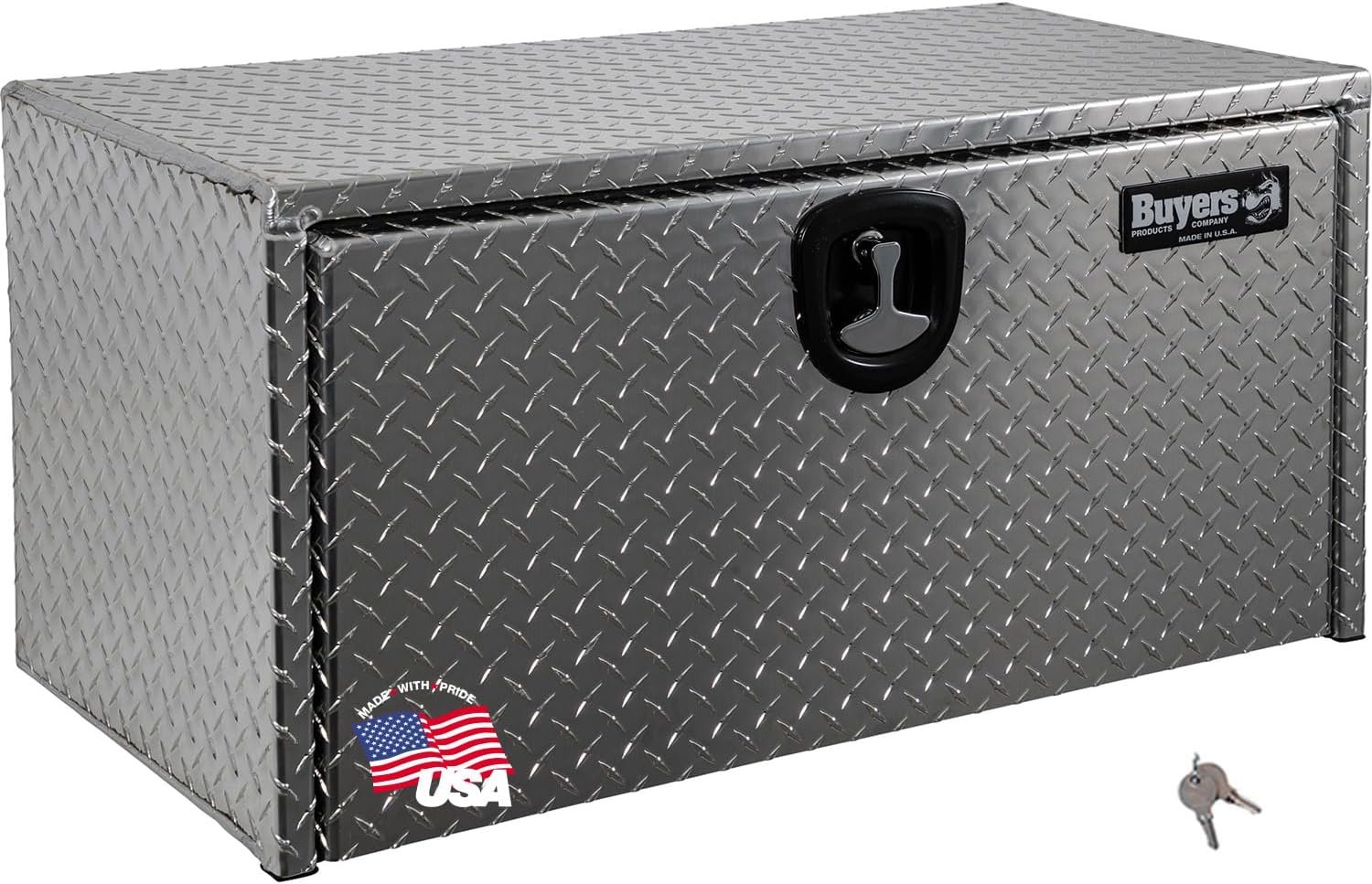
The Buyers Products 1705105 36 x 18 x 18 Inch Aluminum Underbody Tool Box is a diamond-tread aluminum storage box designed for truck and equipment applications. The model measures 36 inches wide, 18 inches deep, and 18 inches high, and product specifications identify its weight at approximately 43 pounds. It uses aluminum construction, a recessed drop door, a continuous hidden hinge, a replaceable gasket sealing system, aircraft-grade door cables, and a locking die-cast compression latch.
The box is designed to provide accessible storage without requiring the available cargo area inside the truck bed to be used for every tool or accessory. Buyers Products states that the box can be mounted under a truck bed with appropriate mounting brackets or on a suitable flat surface. The mounting brackets for underbody installation are sold separately.
An underbody toolbox is more than simply a metal container. Its dimensions, door configuration, mounting position, sealing system, latch, and construction material all affect how it fits into a work vehicle and how it can be used in daily operations.
This guide explains the main characteristics of the Buyers Products 1705105, practical ways an underbody toolbox can be used, what to consider before installation, and how aluminum underbody storage compares with other common toolbox categories.
Key Features of the Buyers Products 1705105
36 x 18 x 18 Inch Dimensions
The 1705105 has an overall size of approximately 36 inches wide, 18 inches deep, and 18 inches high. These dimensions create a long rectangular storage compartment that can accommodate tools and equipment that may be awkward to organize inside a smaller box.
The width is particularly relevant for organizing longer hand tools, maintenance equipment, straps, electrical supplies, fittings, and other items commonly carried by service vehicles.
The external dimensions should not, however, be confused with usable internal storage dimensions. Door construction, seals, hinges, latch components, and wall thickness occupy some of the available space.
Before purchasing or installing the box, it is useful to measure the intended mounting area rather than relying only on the advertised dimensions.
Aluminum Construction
The toolbox is constructed from 0.100-inch-thick diamond-tread aluminum. Buyers Products describes the material as corrosion-resistant and designed for demanding outdoor conditions.
Aluminum is commonly used in truck storage equipment because it provides a combination of structural rigidity and relatively low weight compared with many steel alternatives.
For a mobile work vehicle, reducing unnecessary weight can be useful because the toolbox itself contributes to the vehicle’s overall payload. The 1705105 is listed at approximately 43 pounds, although shipping weight can be somewhat higher.
The diamond-tread surface also gives the box the familiar appearance associated with many commercial truck toolboxes.
Diamond-Tread Exterior
The exterior uses a diamond-tread aluminum finish.
Diamond-tread patterns are common on truck equipment because they provide a textured industrial appearance and can help disguise minor surface marks that naturally occur in working environments.
The finish should not be interpreted as making the toolbox immune to scratches, dents, corrosion, or other physical damage. Like other vehicle-mounted equipment, it can be affected by road debris, impacts, chemicals, salt, moisture, and improper installation.
Recessed Drop Door
The 1705105 uses a recessed drop door. The door opens downward to provide access to the storage compartment. Buyers Products describes the recessed design as part of the box’s approach to keeping the door and latch assembly integrated with the overall enclosure.
A drop-down door can also create a temporary working surface when open, depending on the installation and load limitations of the door. It should not automatically be treated as a work platform or seat unless the manufacturer specifically permits that use.
The opening dimensions are smaller than the overall exterior dimensions. One specification source lists an opening of approximately 32.75 inches wide by 15.3 inches high.
This distinction matters when planning what tools or cases need to be stored inside.
Continuous Hidden Hinge
A continuous hidden hinge is used along the door.
Instead of having exposed individual hinge points along the exterior, the hinge is integrated into the design. Buyers Products identifies the hidden hinge as part of the system intended to help keep moisture and road dirt away from the hinge area.
For a truck toolbox exposed to road spray and outdoor conditions, hinge placement can be an important design consideration.
Replaceable Gasket Sealing System
The box incorporates a replaceable gasket sealing system.
A gasket helps create a barrier around the door when it is closed. This is particularly relevant for an underbody toolbox because the storage compartment can be exposed to rain, road spray, dust, mud, and other contaminants.
The manufacturer’s specifications identify a replaceable gasket system, while one distributor describes the seal as a D-bulb-style gasket.
A weather-resistant enclosure should still be installed correctly. A damaged gasket, improperly aligned door, loose mounting, or damaged box can compromise the enclosure.
Locking Die-Cast Compression Latch
The toolbox uses a locking die-cast compression latch.
A compression latch does more than simply hold a door closed. Its design draws the door against the gasket as the latch is secured, helping maintain pressure around the enclosure.
Buyers Products identifies the locking compression latch as part of the system intended to help protect the contents from weather and discourage unauthorized access.
The locking feature is useful for controlled access to stored tools, but a toolbox lock should not be considered equivalent to a high-security safe. The level of protection depends on the entire vehicle, mounting system, surrounding structure, and circumstances.
Aircraft-Grade Door Cables
The door uses cables described by Buyers Products as aircraft-grade cables. These cables help support the drop door when it is opened.
This is an important practical feature because a wide metal door can become heavy and cumbersome when fully open. Door cables help control its position and reduce the likelihood of the door simply dropping open.
The cables should still be inspected periodically, particularly on equipment exposed to frequent opening and closing, road spray, dirt, or harsh weather.
Mounting Flexibility
The 1705105 can be mounted under a truck bed or on an appropriate flat surface. Underbody mounting requires suitable mounting brackets, which are sold separately.
This flexibility can make the box relevant to different truck and equipment configurations.
However, “mounts on a flat surface” does not mean that every flat surface is automatically suitable. The structure supporting the toolbox must be strong enough for the box and its contents, and the mounting method must account for vibration, movement, and the weight of the stored equipment.
How an Underbody Toolbox Can Be Used
Organizing Hand Tools
One straightforward application is the storage of frequently used hand tools.
Wrenches, sockets, pliers, screwdrivers, hammers, measuring equipment, and other maintenance tools can be separated from larger equipment carried elsewhere on the vehicle.
The long 36-inch width provides room for organizing groups of tools rather than placing everything in a small portable toolbox.
For better organization, operators can use tool trays, removable organizers, labeled containers, or smaller cases inside the main compartment.
Storing Vehicle Maintenance Equipment
A service truck may need to carry items such as replacement filters, fittings, gloves, electrical connectors, straps, fasteners, and other maintenance supplies.
An underbody compartment can provide a dedicated location for these items, leaving the main cargo area available for larger equipment.
This can be particularly useful when different categories of equipment need to remain separated.
Electrical and Utility Work
Electricians, utility crews, telecommunications technicians, and maintenance professionals often carry many small components alongside larger tools.
An underbody toolbox can provide a dedicated compartment for items that might otherwise become scattered across the truck.
Examples could include cable accessories, hand tools, fasteners, connectors, protective equipment, and maintenance supplies.
The suitability of the compartment for sensitive electronic equipment depends on the environmental conditions and the level of protection required. A gasketed metal toolbox should not automatically be treated as a climate-controlled or condensation-proof enclosure.
Construction and Contractor Vehicles
Contractors can use underbody storage to separate frequently needed tools from larger materials.
For example, a truck might carry power equipment and building materials in the bed while using an underbody compartment for hand tools, measuring equipment, fasteners, or replacement accessories.
The advantage is primarily organizational: different types of equipment can have designated storage locations.
Roadside and Emergency Equipment
Service vehicles can also use dedicated compartments for roadside equipment.
Depending on the vehicle and company procedures, this could include reflective equipment, work gloves, basic hand tools, straps, replacement components, or other supplies.
Items should be selected according to the vehicle’s actual purpose and the operator’s safety procedures.
Who May Find This Type of Toolbox Useful?
Mobile Service Technicians
A technician who spends much of the working day traveling between job sites may benefit from having frequently used tools stored outside the cab but still within easy reach.
An underbody box can create a dedicated storage area that does not consume passenger space.
Utility and Fleet Operators
Utility vehicles often have specialized equipment mounted to the truck, leaving limited conventional cargo space.
Underbody storage can complement existing compartments and help distribute equipment around the vehicle.
Contractors
Contractors who transport both materials and tools can use different compartments for different categories of equipment.
The 36-inch width can be useful for organizing longer tools or groups of smaller tools.
Truck Upfitters
Truck equipment installers and fleet builders may incorporate underbody storage into customized work vehicles.
The 1705105 is specifically listed for truck equippers, truck installers, truck upfitters, and maintenance professionals by one distributor.
Fleet Managers
For fleets, standardized storage can make it easier to establish consistent equipment layouts.
However, fleet managers should confirm mounting compatibility for each vehicle model and account for differences in frame dimensions, exhaust systems, fuel tanks, suspension components, and other underbody equipment.
Important Things to Consider Before Installation
Measure the Mounting Area
Before installing a 36 x 18 x 18-inch toolbox, measure the available space carefully.
Under a truck, the nominal space may look sufficient until other components are considered. Exhaust systems, fuel tanks, wiring, suspension parts, hydraulic equipment, spare tires, and frame structures can affect the available clearance.
The toolbox should not interfere with moving components, heat sources, electrical systems, or routine vehicle maintenance.
Consider the Door Opening
The external width of the box is 36 inches, but the usable door opening is smaller. One published specification lists the opening at approximately 32.75 inches wide and 15.3 inches high.
When deciding what to store inside, measure the actual equipment rather than assuming that an item will fit because it is smaller than the outside dimensions.
This is especially important for rigid cases, long tools, and boxed equipment.
Mounting Hardware Is Separate
The box itself does not necessarily include the brackets required for underbody installation.
Buyers Products specifies that mounting brackets are sold separately for under-bed installation.
The exact mounting solution depends on the vehicle and installation configuration. Using appropriate hardware is important because the box can become substantially heavier once loaded.
Account for Total Weight
The toolbox itself weighs approximately 43 pounds.
That is before tools, equipment, parts, or supplies are placed inside.
A fully loaded toolbox can therefore add substantially more weight to the vehicle. The additional weight should be considered as part of the vehicle’s overall payload and axle-loading requirements.
Check Ground Clearance
An underbody box should not significantly compromise the vehicle’s necessary ground clearance.
This becomes especially important for work trucks that regularly travel over uneven terrain, construction sites, rural roads, or other areas where the underside of the vehicle may encounter obstacles.
The mounting position should provide sufficient clearance for the vehicle’s normal operating environment.
Consider Heat Sources
Underbody locations can expose equipment to heat generated by exhaust components and other vehicle systems.
The intended mounting position should be evaluated for temperature exposure. Stored materials should also be compatible with the expected environment.
Consider Corrosive Environments
Aluminum offers corrosion resistance, but that does not mean it is immune to environmental damage.
Road salt, chemicals, fertilizers, industrial contaminants, and trapped moisture can affect vehicle-mounted equipment and its hardware.
Regular inspection and cleaning can help identify developing issues.
Weather Resistance and Storage Protection
A major reason for selecting an underbody toolbox is the desire to keep equipment enclosed.
The 1705105 combines a recessed door, continuous hidden hinge, replaceable gasket, and compression latch as part of its enclosure design.
These features can help limit exposure to ordinary outdoor conditions when the box is correctly closed and maintained.
Still, weather resistance should be understood realistically.
A gasket can deteriorate. The door can become misaligned. Mounting hardware can loosen. Damage to the box can create openings. Dirt can accumulate around sealing surfaces.
For equipment that is particularly sensitive to moisture, additional protective cases or containers inside the toolbox may be appropriate.
Aluminum vs. Steel Underbody Toolboxes
Aluminum and steel are two common materials used for truck storage boxes.
Neither material is automatically appropriate for every application.
Aluminum Toolboxes
Aluminum is relatively lightweight and naturally corrosion-resistant compared with untreated steel.
This makes it attractive for work trucks where equipment weight matters.
The 1705105 uses 0.100-inch diamond-tread aluminum and weighs approximately 43 pounds.
Steel Toolboxes
Steel boxes can offer different structural characteristics and may be selected for applications where durability and resistance to certain forms of physical abuse are priorities.
The tradeoff is that steel construction can add more weight, depending on the design.
Powder-Coated or Painted Boxes
Some steel and aluminum boxes use coatings to provide a different appearance or additional surface protection.
Coatings can eventually be scratched or damaged, so their condition should be monitored.
Choosing Between Materials
The practical decision should consider:
- Vehicle payload
- Environmental exposure
- Desired weight
- Physical demands
- Mounting structure
- Maintenance requirements
- Security expectations
- Appearance
- Storage needs
The goal is to match the toolbox construction to the working environment rather than assuming that one material is universally superior.
Underbody vs. Cross-Bed Toolboxes
Another useful comparison is the mounting location.
Underbody Storage
An underbody toolbox uses otherwise unused space beneath the vehicle.
This can leave the truck bed open for larger equipment, materials, pallets, machinery, or other cargo.
The tradeoff is that installation can be more involved, and clearance must be considered carefully.
Cross-Bed Storage
A cross-bed toolbox is typically installed across the truck bed behind the cab.
It is often easy to access from above and can provide a substantial storage compartment, but it occupies part of the bed.
Side-Mounted Storage
Some work trucks use side-mounted or side-access compartments integrated into custom bodies.
These can provide convenient access while maintaining a particular vehicle layout, although installation requirements vary.
The appropriate configuration depends heavily on the truck and how it is used.
Organizing the Interior
An empty toolbox can become disorganized surprisingly quickly.
A practical organization strategy is to assign areas to specific categories.
For example, one section could hold hand tools, another could hold consumables, and another could be reserved for emergency or replacement equipment.
Smaller containers can be useful for fasteners, electrical connectors, fittings, and other small items.
Labels can also help technicians identify where equipment belongs. This is particularly valuable in fleet environments where multiple operators use the same vehicle.
The toolbox does not include an internal shelf according to published specifications, so users who need compartmentalized storage may want to add removable organizers rather than permanently modifying the box.
Any modification should be considered carefully because drilling holes or altering the enclosure could affect weather resistance and structural integrity.
Maintenance and Inspection
Routine inspection can help extend the useful life of vehicle-mounted storage equipment.
Inspect the Gasket
Check the gasket for cracking, flattening, separation, or other signs of deterioration.
A damaged gasket may reduce the enclosure’s ability to keep out moisture and debris.
Check the Latch
The compression latch should operate smoothly and close the door securely.
If the door no longer compresses against the gasket correctly, investigate the alignment and hardware rather than simply forcing the latch.
Inspect the Door Cables
The door cables should be checked for fraying, damage, corrosion, or other abnormalities.
A damaged cable can affect how the drop door is supported when open.
Check Mounting Hardware
Vehicle vibration can place continual stress on mounting hardware.
Periodic inspection of bolts, brackets, fasteners, and mounting points is therefore sensible.
Clean the Sealing Surfaces
Dirt and debris around the gasket can interfere with proper sealing.
Cleaning the relevant surfaces periodically can help maintain consistent contact between the gasket and door.
Security Considerations
The 1705105 has a locking compression latch, providing a way to secure the compartment when the vehicle is unattended.
However, toolbox security should be viewed as part of a larger vehicle-security system.
A determined thief may target the entire vehicle or attempt to access mounting hardware. The security of the stored tools therefore depends on factors such as the vehicle itself, parking environment, mounting method, and what is stored inside.
For expensive equipment, additional security measures may be appropriate.
It is also useful to avoid leaving unnecessary high-value equipment inside a vehicle when it will be unattended for extended periods.
Frequently Asked Questions
What are the dimensions of the Buyers Products 1705105?
The toolbox measures approximately 36 inches wide, 18 inches deep, and 18 inches high.
What material is the 1705105 made from?
It is constructed from 0.100-inch-thick diamond-tread aluminum. Buyers Products describes the aluminum as corrosion-resistant and intended for demanding outdoor use.
How much does the toolbox weigh?
Published specifications list the toolbox at approximately 43 pounds. Shipping weight may be higher depending on packaging.
Does the toolbox lock?
Yes. The 1705105 uses a locking die-cast compression latch.
Is the mounting hardware included?
Underbody mounting brackets are sold separately according to Buyers Products’ product information.
The exact hardware required can depend on the truck and installation configuration.
Can it be mounted somewhere other than underneath a truck?
Buyers Products states that the box can be mounted on a suitable flat surface as well as under a truck bed.
The supporting structure and mounting method should be appropriate for the loaded toolbox.
Is the toolbox weather resistant?
The box incorporates a recessed door, gasket sealing system, continuous hidden hinge, and compression latch intended to help protect contents from outdoor exposure.
It should still be maintained properly, and sensitive equipment may benefit from additional internal protection.
What is the door opening size?
One published specification lists an opening of approximately 32.75 inches wide by 15.3 inches high.
This is smaller than the toolbox’s overall 36-by-18-inch exterior dimensions and should be considered when storing larger equipment.
Does the box have an internal shelf?
Published specifications for this model indicate no internal shelf.
Users can organize the interior with removable trays or containers according to their needs.
Is aluminum a good material for an underbody toolbox?
Aluminum is commonly used for truck toolboxes because it can provide corrosion resistance while keeping weight relatively manageable.
Whether it is suitable for a particular vehicle depends on the environment, expected use, payload requirements, and the type of equipment being stored.
Can it be used on any truck?
Not necessarily. Although the toolbox itself is intended for truck applications, the physical space and mounting structure vary between vehicles.
The available clearance, frame configuration, exhaust location, suspension movement, and other underbody components should be checked before installation.
What kinds of tools can be stored inside?
The compartment can be used for many categories of tools and equipment, including hand tools, maintenance supplies, fittings, electrical accessories, straps, replacement parts, and other work equipment that fits through the door opening.
The storage environment should also be considered for moisture-sensitive or temperature-sensitive items.
Is the drop-down door designed to support weight?
The door provides access to the toolbox and is supported by door cables when open. It should not automatically be treated as a workbench, step, or platform unless the manufacturer specifically rates it for such use.
Does the toolbox replace a truck-bed toolbox?
Not necessarily. Underbody and truck-bed toolboxes serve different purposes.
An underbody box can complement existing storage and preserve truck-bed space, while a bed-mounted box may provide easier top access or a different storage configuration.
Conclusion
The Buyers Products 1705105 36 x 18 x 18 Inch Aluminum Underbody Tool Box is designed around a practical need in commercial and work-truck environments: creating dedicated enclosed storage without consuming the primary cargo area of the truck bed.
Its 36 x 18 x 18-inch dimensions, 0.100-inch diamond-tread aluminum construction, recessed drop door, continuous hidden hinge, replaceable gasket, aircraft-grade door cables, and locking compression latch provide a combination of storage access, enclosure features, and vehicle-oriented construction.
The toolbox can be relevant to service technicians, contractors, utility fleets, truck upfitters, maintenance professionals, and other users who need additional organized storage on a work vehicle.
At the same time, choosing an underbody toolbox involves more than checking the box dimensions. The available mounting space, vehicle structure, ground clearance, exhaust and suspension components, payload capacity, mounting hardware, and intended contents should all be considered before installation.
The box’s weather-resistant design can help protect tools and equipment from ordinary outdoor exposure, but regular inspection remains important. Gaskets, door cables, latches, mounting hardware, and sealing surfaces can all experience wear over time.
For users comparing aluminum, steel, bed-mounted, and underbody storage options, the right choice ultimately depends on the vehicle configuration and the type of work being performed. The 1705105 is particularly oriented toward applications where a relatively lightweight aluminum enclosure and underbody access are useful parts of the overall storage plan.
If the dimensions, mounting configuration, and storage characteristics match your vehicle and work requirements,
you can check more details on Amazon here.
As an Amazon Associate, we earn from qualifying purchases.
Leave a Reply